For decades, American trade and industrial policy operated on a set of assumptions: global markets would always deliver, cheap imports were a feature not a vulnerability, and we didn’t need to make, mine, refine, or produce it here as long as someone else would.
Some of those bets worked in the short term. Others didn’t. And the ones that didn’t have a way of showing up all at once: at the pump, at the port, and at the grocery store.
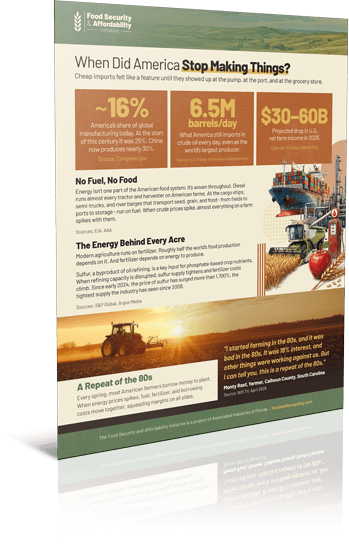
America’s share of global manufacturing today. At the start of this century it was 25%. China now produces nearly 30%.
What America still imports in crude oil every day, even as the world’s largest producer. We export the light crude our shale fields produce and import the heavy crude our refineries were built to process.
Since America built its last major oil refinery. Nearly a million barrels per day of refining capacity has been lost since 2020 alone.
America’s food supply is only as secure as the supply chains behind it. Here’s what that actually means for American families.
Refineries went offline. Rail infrastructure aged. Storage capacity was never built to scale. Our supply chain looked functional, right up until it wasn’t.
Most Americans felt it first at the pump. But energy was just the most visible example. The same dynamic has been quietly at work in another system—one that doesn’t make headlines until planting season gets expensive, or the grocery bill jumps, or a farmer has to decide whether it’s worth putting in a full crop.
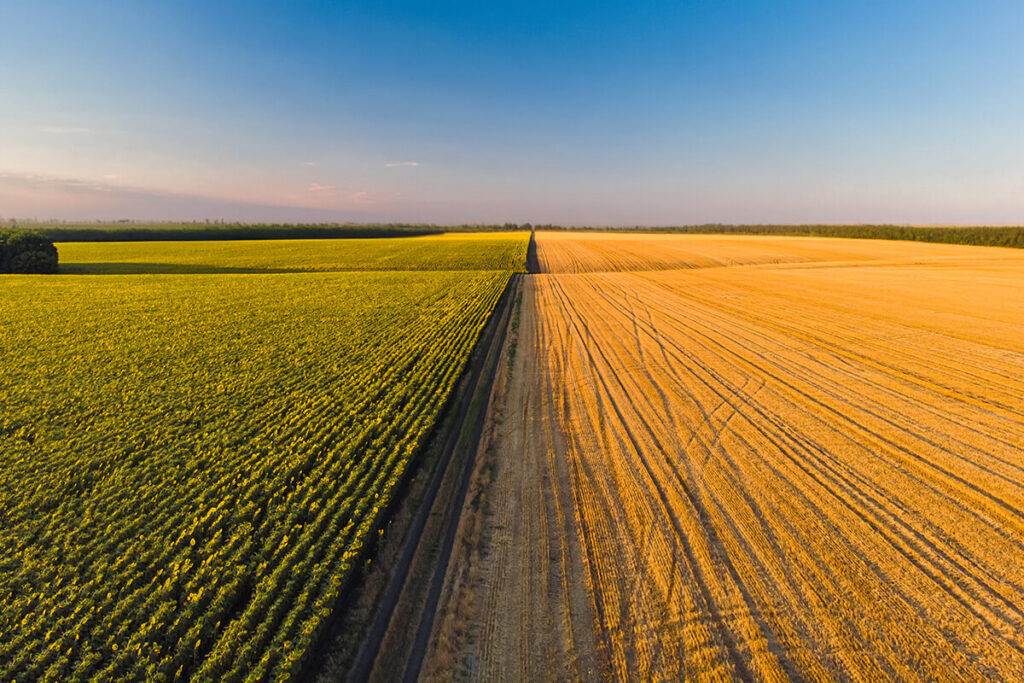
The system that grows our food.
“An affordable and secure food supply is vital to America’s national and economic security.”
Most people think of oil and gas as what goes in the tank. But energy does a lot more than move vehicles. Crude oil refining produces the sulfur that goes into phosphate fertilizer. Natural gas is the primary feedstock for ammonia, another essential building block of modern fertilizer. Diesel runs almost every tractor, truck, and harvester on American farms. The cargo ships, semi trucks, and river barges that move seed, grain, and food from field to port to store all need fuel.
Energy isn’t just one part of the American food system. It’s woven throughout. And it runs through infrastructure that hasn’t been meaningfully expanded in decades. America hasn’t built a major oil refinery in 50 years.
Since the start of 2026, global crude oil prices have roughly doubled. That doesn’t mean one thing got more expensive for American families and farmers. It means almost everything did, and all at the same time.
When costs rise, farmers have to make hard choices. Fewer acres. Less fertilizer per acre. Scaled-back operations. Those choices show up months later as tighter supply, lower yields, and higher prices at the grocery store.
Securing the American food supply means extending the same strategic thinking we apply to oil—reserves, domestic capacity, diversified sources—to the full chain of materials that agriculture depends on.
The projected drop in U.S. net farm income in 2026 from recent peak levels, as fuel, fertilizer, and financing costs hit simultaneously.
Source | Purdue University
Modern agriculture runs on fertilizer. Without it, crop yields would fall dramatically — scientists estimate that roughly half the world’s food production depends on mineral fertilizers. It’s not optional, it’s fundamental.
Fertilizer comes in several forms, and each one is manufactured from a variety of raw materials. All of them depend on functional global supply chains to move from production hubs to American farms.
Nitrogen fertilizers rely on ammonia produced via the Haber–Bosch process using natural gas as the main hydrogen feedstock.
Phosphate fertilizers depend heavily on sulfuric acid made from sulfur recovered from oil and gas refining.
Potash fertilizers are produced by mining potassium‑rich salt deposits.
That supply chain runs through some of the most volatile parts of the world. Key raw materials are produced in the Middle East, Eastern Europe, and other regions subject to conflict, sanctions, and disruption. When those regions are destabilized, the materials that go into fertilizer get more expensive. So does the cost of growing food.
“When the supply chain that produces fertilizer is unstable, our food security becomes unstable too.”
Every spring, most American farmers borrow money to plant. Seeds, fuel, fertilizer, equipment. A line of credit is often how the season starts, and when that credit gets harder to access, the math changes.
That’s not just a farm finance problem. When farmers plant fewer acres, grow less, or switch to less nutrient-intensive crops to cut costs, the effects travel. Tighter supply. Lower yields. Higher prices at the grocery store months later.
Energy-driven inflation doesn’t stay at the pump or the co-op. It moves through the whole system. Fuel costs, fertilizer costs, and borrowing costs are intertwined. When energy spikes, all three move together, compressing margins from every direction at once.
Targeted relief for farmers matters in the short term. But so does addressing the underlying cost pressures. When energy is stable, costs are stable.
And when costs are stable, farmers plant.

“I started farming in the 80s, and it was bad in the 80s. It was 18% interest, and other things were working against us. But I can tell you, this is a repeat of the 80s.”
Source | WIS10
Fuel, financing, fertilizer. They feel like separate problems. But pull on any one of them and you end up in the same place: global energy markets, disrupted supply chains, and raw materials that most Americans may never think about.
For example: Sulfur. It’s one of the essential building blocks for certain fertilizers. When its price moves, the cost of growing food moves with it.
Sulfur is a byproduct of oil refining. When refining capacity is disrupted by war, sanctions, or damaged infrastructure, global sulfur supply tightens. The same disruptions push ammonia, fuel, and freight costs higher. These aren’t isolated shocks. They often move together, and they all flow through to what every American pays at the grocery store.
Sulfur trading near baseline. Industrial demand from the metals sector begins climbing, tightening global supply before any conflict enters the picture.
Ukraine’s sustained strikes on Russian oil infrastructure reduce refinery output, cutting into sulfur supply as demand continues rising. Prices nearly triple from baseline.
Conflict in the Middle East disrupts energy shipments through key routes. A market already under pressure surges further.
Global prices reach their highest point in recent history. A 900% increase in roughly 18 months, driven by compounding disruptions on top of a demand base that was already growing.
Increase in sulfur in some markets
the amount of sulfur required to produce 1 tonne of phosphoric acid, which is used to produce phosphate fertilizer
added to the cost of producing phosphate fertilizer
That’s $400 more per tonne before the product ever leaves the facility. Before it reaches the wholesaler, the co-op, or the farm. And that’s just one of the raw materials behind one type of fertilizer. Multiply it across fuel, financing, and the full supply chain, and the pressure on American farms and families becomes clearer.
Source | Argus Media | S&P Global
Every pound of meat and every gallon of milk starts with feed. And the feed that keeps American livestock healthy depends on vitamins that the United States barely produces anymore.
Modern livestock production runs on vitamin premixes. Vitamin A. Vitamin E. B vitamins. These micronutrients are added to every commercial feed ration for poultry, cattle, and swine. Without them, animals grow more slowly, get sick more often, and produce less. They are not optional. They are as fundamental to livestock farming as fertilizer is to crop farming.
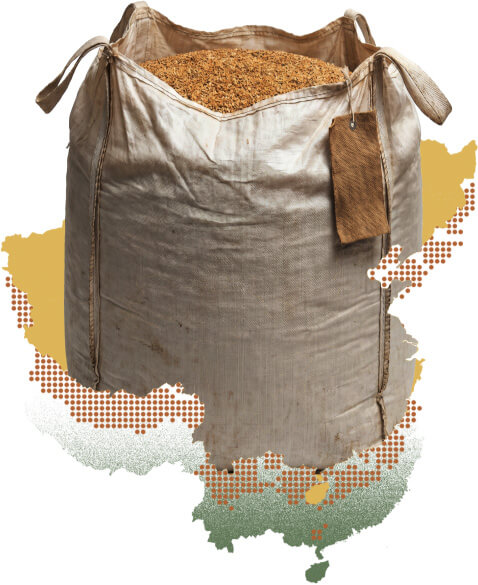
They are also made almost entirely in China. The United States depends on China for 78% of its vitamin imports used in animal feed. For specific vitamins the dependency is essentially total:
both essential in livestock feed, with no meaningful manufacturing capacity anywhere else in the world. There is not enough production capacity outside China to cover U.S. demand if that supply is disrupted.
“The result is a meat and dairy supply that runs through a single country’s factories. That’s not an efficient supply chain. It’s a fragile one.”
Planting a crop is only the first step. Keeping it alive is another.
Modern agriculture depends on crop protection chemicals like herbicides, insecticides, and fungicides to control the weeds, pests, and diseases that can wipe out a field before harvest.
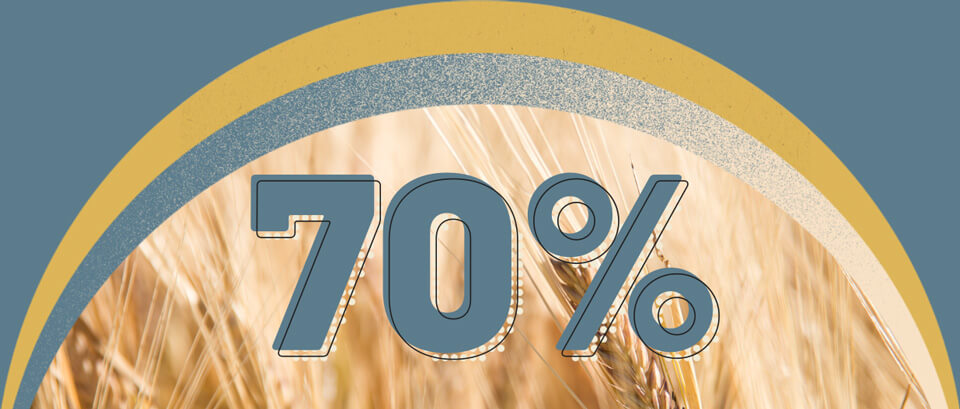
But the supply chain behind them isn’t domestic. China produces nearly 70% of the world’s active ingredients for crop protection.
We’re dependent on foreign countries to protect our crops.
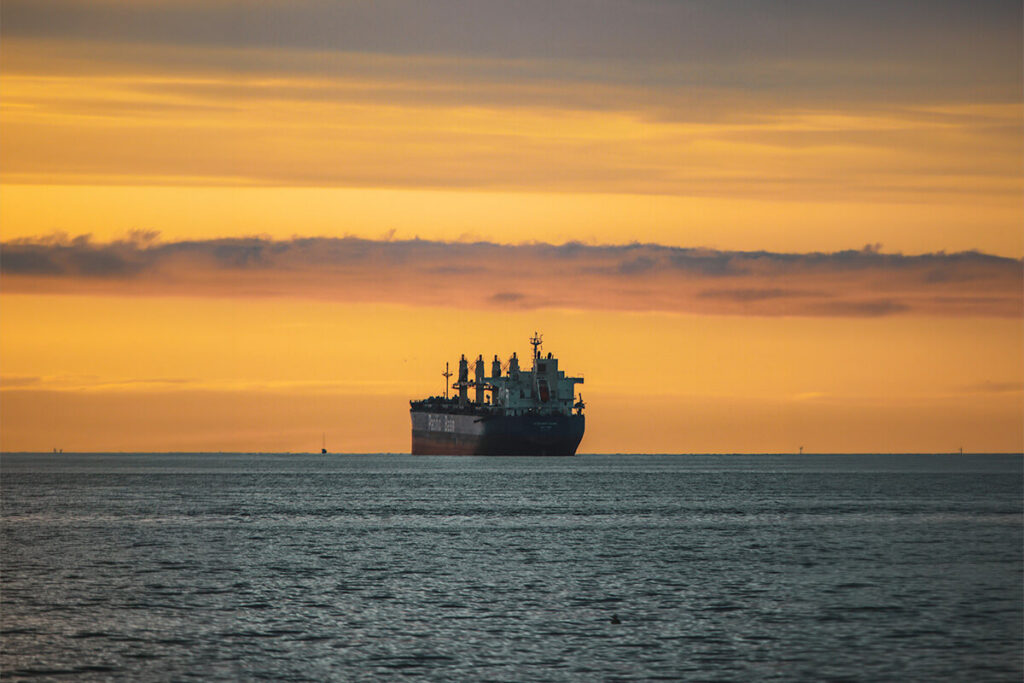
It starts far from any American farm. A conflict breaks out. A shipping lane closes. A refinery goes offline. Events that most Americans follow as news, not as something that affects what they’ll pay for groceries next month.
But the ripple moves fast.
Global Conflict / Energy Disruption
Crude Oil, Natural Gas, Sulfur, Ammonia
Crude oil prices spike. Natural gas follows. Sulfur, a byproduct of oil refining, tightens in global markets. Ammonia, which depends on natural gas to produce, gets more expensive. Diesel used for tractors, trucks, grain dryers, and harvesters climbs alongside them.
Then it reaches producers.
Fertilizer, diesel, farm chemicals, transport
Fuel costs go up. Fertilizer costs go up. The things farmers use to protect crops, the packaging that moves food through the supply chain, the trucks that deliver it. All of it is downstream of energy, and all of it moves when energy moves.
Then it reaches the farm.
Planting costs, fuel costs, borrowing costs
Planting costs rise. Borrowing costs rise. Farmers make hard choices: fewer acres, different crops, less product per acre. Some of those choices show up in yields. Some show up in what gets planted at all.
And then it reaches the table.
Food supply, food prices, American families
Less production means tighter supply, and tighter supply means higher prices. American families spend more on food because of something that happened 6 months ago halfway around the world.
This is how food security works. Or doesn’t.
Understanding this chain is the first step toward protecting it. Policies that stabilize energy, strengthen domestic supply, and reduce dependence on foreign countries don’t just help farmers. They help America.
The United States is one of the most productive agricultural nations on earth. But the raw materials that make that productivity possible depend heavily on a global supply chain concentrated in some of the world’s most unstable regions.
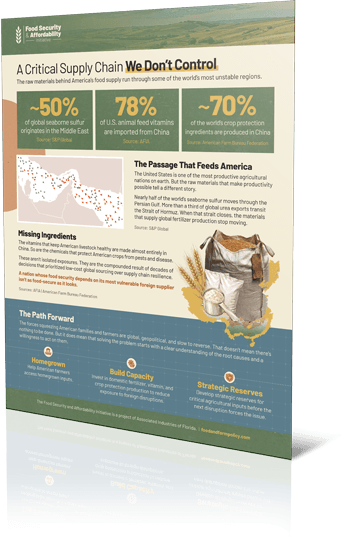
Share of global seaborne sulfur originating in the Middle East
Source | S&P Global
Share of global urea exports transiting the Strait of Hormuz
Source | S&P Global
Share of world pesticide active ingredients produced in China
Source | American Farm Bureau Federation
Nearly half of the world’s seaborne sulfur originates in the Middle East. More than a third of global urea exports — the most widely used form of nitrogen fertilizer — transit the Strait of Hormuz. A quarter of globally traded ammonia moves through the same chokepoint. When that strait closes, the materials that supply global fertilizer production stop moving.
Potash tells a different version of the same story, with Russia and Belarus supplying a significant share of global production. Crop protection chemicals follow the same pattern: China produces nearly 70% of the world’s pesticide active ingredients.
This is the result of decades of decisions that prioritized low-cost global sourcing over supply chain resilience. A nation whose food security depends on its most vulnerable foreign supplier isn’t as food-secure as it looks.
These graphics break down the most important data into simple, easy-to-use formats, making it easier to understand and share.
These one-pagers pull together the key facts in a format that’s easy to reference, save, or share.
The forces squeezing American families and farmers are global, geopolitical, and slow to reverse. That doesn’t mean there’s nothing to be done. But it does mean that solving the problem starts with a clear understanding of the root causes and a willingness to act on them.
The Food Security and Affordability Initiative is a project of Associated Industries of Florida (AIF), Florida’s leading business advocacy organization. AIF advocates for the policies and supply chains that keep Florida’s economy strong. That starts with a secure, affordable food supply.